- 移动端


云舟生物科技(广州)股份有限公司品牌商
8 年
手机商铺
- NaN
- 0
- 0
- 1
- 0




公司新闻/正文
Gutless腺病毒治疗杜兴型肌营养不良(DMD)
591 人阅读发布时间:2023-06-05 11:02
Cargo size is key
Duchenne Muscular Dystrophy (DMD) is a genetic disease that affects ~1 in every 5,000 people. The disease results in muscle weakness and loss, eventually resulting in death due to a genetic mutation in the dystrophin gene. Dystrophin is the largest known gene in the human genome and spans over 2.4 megabases of DNA, taking ~16 hours to be transcribed by RNA polymerase. Due to the large size of this gene, viral vector systems like AAV and lentivirus are not capable of delivering the entire gene for therapy.
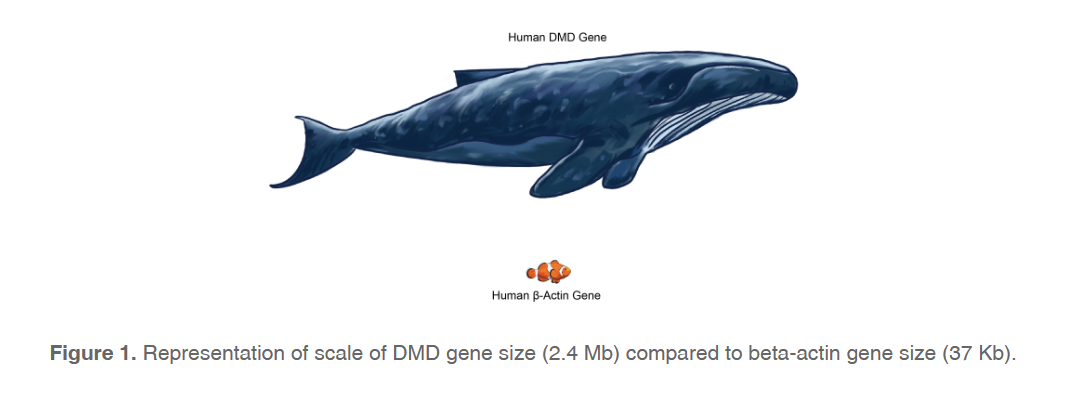
While other approaches to treat DMD have been explored using AAV vectors, these constructs deliver a miniature version of the Dystrophin gene due to the constraints of the vector cargo size. AAV’s carrying capacity is limited to transgenes that are 4.7 kb in length. AAV gene therapies expressing micro-dystrophin for DMD are at different stages of clinical trials and results are currently being evaluated. While AAV systems are widely used for gene therapy and the immune response and side effects have been minimal in clinical trials, a system that can replace the full-length dystrophin gene merits clinical investigation.
CRISPR gene editing also is being investigated as a potential treatment for DMD. In this approach mutations can be targeted for correction. This approach has been investigated in pre-clinical models; however, DMD can arise from a variety of different mutations, therefore, this therapeutic approach may need optimization dependent on different genetic mutations. In addition, certain mutations that cause DMD cannot be rescued by current CRISPR/Cas9 technology.
Gutless adenovirus
Adenovirus is a popular gene delivery system due to the transient, episomal nature of transgene expression, and its relatively large cargo size. Popular serotypes of adenovirus include Human Ad5 and chimeric Ad5/F35. Human Ad5 binds to and enters cells through the coxsackie and adenovirus receptor (CAR), however, in therapeutic and experimental systems that do not express high levels of CAR, the chimeric Ad5/F35 serotype can be used to circumvent this issue. The chimeric Ad5/F35 serotype contains portions of the F35 serotype which binds to CD45, a widely expressed transmembrane receptor.
Gutless adenovirus (GLAd) is a popular alternative to the above-mentioned strains. GLAd is produced via a different method than traditional recombinant adenovirus strains. In the gutless method, a linearized plasmid is co-transfected with a helper virus that contains a floxed packaging signal into cells expressing a Cre recombinase. The helper virus is subsequently inactivated through Cre recombination, and crude virus is extracted from the cells followed by further amplification. Due to this production method, gutless adenovirus lacks nearly all viral sequences except those necessary for packaging and replication, allowing for insertion of large transgenes of interest. Unlike the other systems, GLAd has enough cargo capacity to express an entire copy of mature Dystropin mRNA (14.0 kb) TWICE!
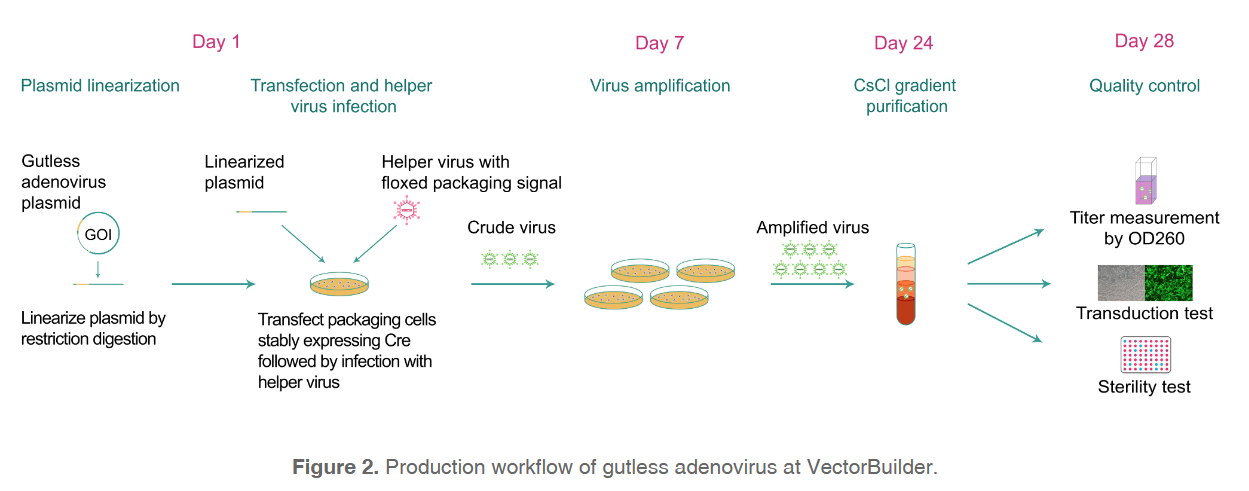
GLAd’s use is currently being explored to treat a wide range of genetic disorders including Huntington’s disease and DMD. The use of GLAd for gene therapy is particularly attractive due to its extremely large cargo size relative to the other systems that are currently in use. Production of GLAd at VectorBuilder can currently accommodate 33 kilobases of genetic payload compared to another commonly used system, AAV, which can hold 4.4 kilobases.
In fact, researchers at the University of McGill attempted the approach of expressing two copies of the mouse dystrophin genes and observed major therapeutic benefits in a mouse model of muscular dystrophy. Although expression of the dystrophin gene was eventually lost, further optimizing this system could lead to a potential life-changing therapeutic for DMD.1
Conclusion
Duchenne muscular dystrophy is a debilitating genetic disease that results in progressive muscle weakening and eventually patients will succumb to their disease. Currently, there are no cures for DMD; therefore, there is an urgent need for further investigation into potential genetic therapies for the disease. GLAd is a recently developed technology that allows for long term, episomal, expression of transgenes with negligible immune side effects. Adenovirus has previously been used to deliver replacement dystrophin in a mouse model of DMD and clinical applications of adenovirus for gene therapy are beginning to emerge.
To learn more about how you can collaborate with VectorBuilder for your gutless adenovirus project click here.
Sources
1. Dudley RW, Lu Y, Gilbert R, Matecki S, Nalbantoglu J, Petrof BJ, Karpati G. Sustained improvement of muscle function one year after full-length dystrophin gene transfer into mdx mice by a gutted helper-dependent adenoviral vector. Hum Gene Ther. 2004 Feb;15(2):145-56. doi: 10.1089/104303404772679959. PMID: 14975187.
2. Ricobaraza A, Gonzalez-Aparicio M, Mora-Jimenez L, Lumbreras S, Hernandez-Alcoceba R. High-Capacity Adenoviral Vectors: Expanding the Scope of Gene Therapy. Int J Mol Sci. 2020 May 21;21(10):3643. doi: 10.3390/ijms21103643. PMID: 32455640; PMCID: PMC7279171.
3. Palmer D, Ng P. Improved system for helper-dependent adenoviral vector production. Mol Ther. 2003 Nov;8(5):846-52. doi: 10.1016/j.ymthe.2003.08.014. PMID: 14599819.
4. Elangkovan N, Dickson G. Gene Therapy for Duchenne Muscular Dystrophy. J Neuromuscul Dis. 2021;8(s2):S303-S316. doi: 10.3233/JND-210678. PMID: 34511510; PMCID: PMC8673537.